Newsroom
Vitalik Buterin Endorses leanPCS Approach for Ethereum Post-Quantum Signatures
16 November, 2026 / News / AI / Tags: leanpcs, leanstark, eip, kilobytes, buterin

Ethereum co-founder shifts stance on leanPCS, backing it within the EIP-8288 draft to ease verification of larger quantum-resistant signatures and proofs
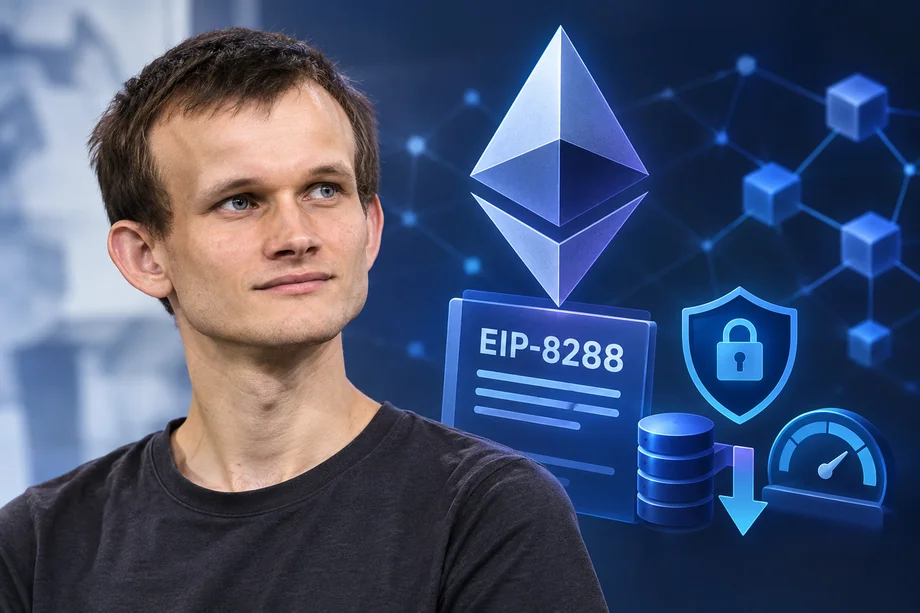
Ethereum co-founder Vitalik Buterin publicly supported leanPCS on November 16 as a practical option for handling the verification load of post-quantum cryptography. The shift follows weeks in which his assessment moved from strong skepticism to clear approval of the method in connection with the EIP-8288 draft proposal.
Buterin discussed leanPCS together with leanSPHINCS, a hash-based signature design, and leanSTARK, a broader proof system that would require agreement on an instruction-set architecture. He presented leanPCS, which relies on polynomial commitments, as a route that could support more flexible proof verification before the network settles on a full instruction-set architecture.
Details of the EIP-8288 Proposal
EIP-8288, co-authored by Buterin and Thomas Coratger, proposes bundling multiple signature and proof checks into a single recursive STARK. The draft builds on the earlier EIP-8141 frame-transaction proposal and seeks to cut the volume of cryptographic data that network participants must carry and verify individually.
According to the proposal’s rationale, hash-based signature schemes are estimated at two to three kilobytes in size and would require 150,000 to 200,000 gas for verification. Hash-based STARK proofs are placed above 128 kilobytes, with sizes potentially reaching 512 kilobytes when optimized for faster generation. These figures are estimates contained in the draft rather than measured results from live tests.
The draft sets an aggregation interval of one second and projects roughly 256 kilobytes of fixed STARK-related overhead for builders in each interval. Transactions would carry lightweight dependency claims that are aggregated off-chain into one recursive STARK, so that only the aggregated proof and compact claim hashes need to appear on-chain.
Role of leanPCS Within the Framework
leanPCS is positioned as a possible way to achieve general cryptographic proof verification more quickly than waiting for consensus on an instruction-set architecture required by leanSTARK. With a polynomial-commitment interface supplied by the EIP-8288 mechanism, a STARK could be verified inside the EVM at an estimated cost of 20,000 to 40,000 gas.
Buterin noted that leanPCS offers the same level of generality as leanSTARK while requiring fewer protocol-level decisions up front. Specifying a polynomial commitment scheme mainly involves choosing a field, with a 128-bit binary field identified as a natural candidate. The trade-off is that leanPCS may need multiple on-chain claims to complete a single computation, making it less efficient on-chain than leanSTARK, though potentially more flexible and efficient for off-chain proof generation.
The current text of EIP-8288 specifies leanSPHINCS and leanSTARK but does not define leanPCS. The proposal remains a draft. Its reference implementation is listed as “TBD,” and activation would require a network upgrade. No activation date is given.
Context Within Ethereum’s Broader Roadmap
Ethereum’s public roadmap treats the quantum computing threat as not imminent and targets core post-quantum infrastructure for approximately 2029. EIP-8288 addresses the practical burden of checking larger signatures and proofs. It does not replace the network’s existing cryptography or render the chain quantum-safe on its own.
Once quantum-resistant schemes are adopted, signatures are expected to grow from the current 65-byte ECDSA size to between 1 and 6 kilobytes depending on parameters, while zero-knowledge proofs would expand substantially compared with today’s succinct proofs. The aggregation approach in EIP-8288 is intended to keep that additional data volume from saturating block space by performing most of the verification work off-chain and submitting only a compact recursive proof.
Buterin described the combination of the EIP-8288 architecture with leanPCS as a path that could accelerate progress toward more general and efficient cryptographic proof systems without requiring immediate agreement on a full instruction-set architecture. leanSTARK could be added later once that architecture is finalized.

Disclaimer
This article was generated by AI using information from multiple industry sources. It has not been reviewed or verified by a human editor and may contain inaccuracies, omissions, or misinformation. Readers are encouraged to independently verify any information before making decisions based on its content.Tired of the noise?
Let the bots trade for you.
Trade 24/7, without emotion, with data-driven strategies.
Associated articles
Vitalik Buterin Backs EIP-8288 for Ethereum Cryptographic Proof Aggregation

Vitalik Buterin Proposes Ethereum Transaction Redesign for Parallel Validation and Scaling

Ethereum Developers Draft Post-Quantum Deposit Contract to Retire BLS Signatures

Vitalik Buterin Outlines Lean Ethereum Roadmap for Quantum Security and Scaling

Ethereum Draft Introduces Sponsored Batch Proofs for Shared Verification
Latest articles

Strategy Adds 485 Bitcoin While Spending $228 Million on Preferred Share Buybacks

Bitmine Nears 5% of Ethereum Supply With Fresh 7,653 ETH Purchase

Solana Retires Mainnet Beta Label After Six Years, Adopts Protocol Version 1.0

Morgan Stanley Declares Quarterly Dividends Across Multiple Preferred Stock Series