Newsroom
Upbit and Bithumb to Delist STORJ, JASMY and TT on September 14
15 August, 2026 / News / AI / Tags: storj, jasmy, thundercore, upbit, jasmycoin
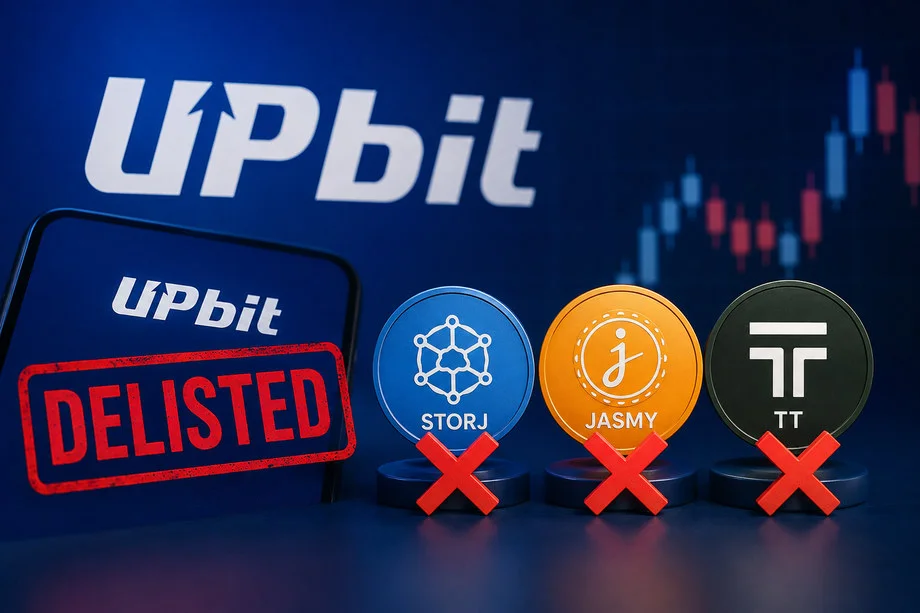
South Korea’s two largest crypto exchanges will end trading support for the three tokens after warning reviews found unresolved concerns over disclosures and project operations
South Korean cryptocurrency exchanges Upbit and Bithumb will terminate trading support for Storj (STORJ),JasmyCoin (JASMY) and ThunderCore (TT) on September 14, 2026, at 3:00 p.m. Korea Standard Time. The decision follows investment caution designations issued in late July and subsequent reviews that concluded the underlying issues remained unresolved.
The move affects six trading pairs on Upbit: STORJ/KRW, STORJ/BTC, JASMY/BTC, JASMY/USDT, TT/KRW and TT/BTC. Bithumb confirmed matching delistings for the same three assets with the identical trading cutoff. All open buy and sell orders will be canceled when support ends. Withdrawals will remain available on both platforms until October 14, after which access closes.
Caution Designations Led to Final Reviews
Upbit first designated STORJ as an asset subject to investment caution on July 28. It added JASMY and TT to the same category on July 31. Both exchanges suspended deposits at the time of the designations and conducted further assessments during a review window that closed in mid-August.
For STORJ and JASMY, the exchanges cited shortcomings in the disclosure of important information that could affect investors, along with questions about the reality, sustainability and actual progress of each project’s business. For ThunderCore, reviewers also examined total supply, circulation plans and the transparency and reasonableness of changes to the project’s business plan.
The exchanges stated that these issues could potentially result in losses for users and that the concerns raised in the original warnings had not been resolved.
Storj Bankruptcy and Project Responses
Storj Labs filed for Chapter 11 bankruptcy protection on July 26 in the U.S. Bankruptcy Court for the Northern District of West Virginia. The company said the filing was intended to address legacy liabilities while allowing its decentralized storage network to continue operating. It has proposed a mechanism that would give token holders a path to equity in a restructured business, subject to court approval and creditor priority. Upbit did not identify the bankruptcy filing as the sole cause of the delisting decision.
ThunderCore publicly disputed the exchanges’ assessment. In an August 1 statement, the project said plans involving TT had been publicly communicated, changes to issuance and token economics had been disclosed, and that its network, issuance mechanism and operational condition remained normal. By August 14, ThunderCore described the upcoming end of trading support as regrettable and noted potential consequences for holders and the ecosystem, while reiterating that its mainnet has operated without interruption since 2019.
No public response from Jasmy addressing the caution designation or the delisting was identified in the materials reviewed.
Immediate Market Reaction and Timeline
The three tokens declined shortly after the notices appeared. ThunderCore fell approximately 6.62 percent, JasmyCoin dropped about 5.25 percent and Storj declined roughly 1.98 percent after a partial recovery. ThunderCore has recorded steeper longer-term declines, with its market capitalization near $1.9 million following sharp 24-hour and 30-day drops. Storj’s market value stands near $19 million, while JasmyCoin remains the largest of the three at approximately $195 million.
After the September 14 cutoff, the exchanges will no longer support services such as airdrops, wallet upgrades or hard forks for the three assets. Deposits made after trading ends may not be credited, and recovery of mistaken transfers could take considerable time.
The sequence follows a pattern seen with other tokens on Korean platforms, in which caution designations precede potential removal if issues are not addressed to the exchanges’ satisfaction. Coinone, another major South Korean exchange, separately extended its own delisting review process for STORJ.
Holders of the affected tokens retain a one-month window after trading ends to move assets to external wallets or other venues that continue to support them. The underlying networks and tokens remain operational independent of the exchange delistings.

Disclaimer
This article was generated by AI using information from multiple industry sources. It has not been reviewed or verified by a human editor and may contain inaccuracies, omissions, or misinformation. Readers are encouraged to independently verify any information before making decisions based on its content.Tired of the noise?
Let the bots trade for you.
Trade 24/7, without emotion, with data-driven strategies.
Associated articles
Upbit to Delist BONK on September 7 After Governance Exploit Review

KAIA Token Jumps Over 50% on Upbit Listing News
Binance to Remove ICON, Secret and Storj from Spot Markets on September 3

GXT Trading Opens on Home Platform as Multi-Exchange Listings Approach
Binance to Remove EPIC and QUICK from Spot Trading on October 28
Latest articles
UK Banks Face Thousands of Complaints Over Crypto Transfer Restrictions

Ripple Backs SEC Proposed Crypto Asset Rules After $150 Million Legal Battle

Blockchain.com Introduces Options Trading on Seven Major Crypto Assets

Solana Activates Alpenglow Upgrade for Sub-Second Transaction Finality