Newsroom
SoFi Bank Activates SoFiUSD Stablecoin Settlement for $25 Billion Mastercard Card Program
22 September, 2026 / News / AI / Tags: sofi, sofiusd, mastercard, settlement, bank
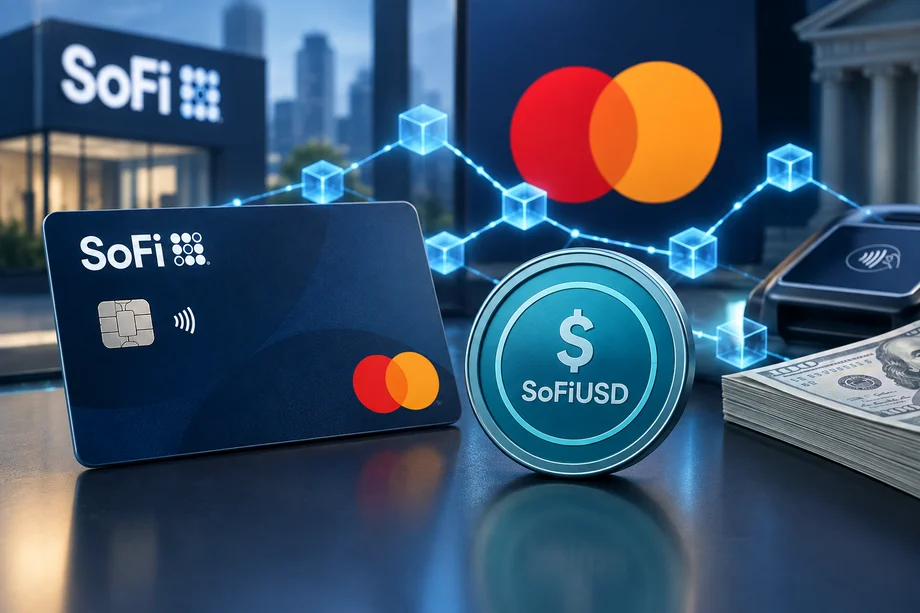
SoFi becomes the first national bank to process live debit and credit card settlements with its bank-issued stablecoin on Mastercard’s global network.
SoFi Technologies and Mastercard confirmed on September 22 that stablecoin settlement using SoFiUSD is now operational across SoFi Bank’s full debit and credit card program. The move places the bank’s expected $25 billion annualized card volume onto blockchain-based settlement within Mastercard’s existing payments infrastructure.
SoFi Bank, N.A., a nationally chartered institution regulated by the Office of the Comptroller of the Currency, is the first bank to complete this transition. Debit and credit transactions under the program are settling with SoFiUSD, the stablecoin issued by the bank itself. The token is redeemable one-to-one for U.S. dollars and is backed primarily by cash reserves.
How the Settlement Works for Merchants
Merchants receiving funds through the program do not need to hold SoFiUSD, operate blockchain wallets, or alter their existing payment processes. Settlement occurs on-chain between relevant parties, after which funds arrive in a SoFi Bank account via the company’s Big Business Banking platform. From there, merchants can convert the proceeds to cash and withdraw at any time, including weekends and holidays, with no withdrawal fee.
The arrangement keeps the merchant experience within traditional banking channels while the underlying settlement uses the stablecoin. SoFiUSD is available to institutions and SoFi members and operates on the Ethereum and Solana networks.
From Partnership to Production in Six Months
The companies announced their collaboration six months earlier. The current launch moves the project from planning into live production. SoFi described the card program as already processing transactions on-chain and projected annualized volume exceeding $25 billion.
Mastercard Global Head of Digital Commercialization Sherri Haymond stated that stablecoins become meaningful when they address everyday operational challenges for businesses. She noted that the companies have brought regulated stablecoin settlement into production while maintaining the safeguards and scale of Mastercard’s existing network.
Broader Mastercard Stablecoin Expansion
The SoFi rollout forms part of Mastercard’s wider initiative to support regulated stablecoin settlement. Earlier in the year the payments company added several tokens, including Circle’s USDC, PayPal USD, Paxos tokens, Ripple’s RLUSD, and SoFiUSD, to its planned settlement infrastructure. Supported transactions can settle outside conventional banking hours across multiple blockchains.
Issuers and acquirers retain their current Mastercard processes while gaining the option to settle in regulated stablecoins. Initial geographic coverage focused on portions of the United States and Latin America, with further expansion planned through 2026.
Next Steps for SoFiUSD
SoFi indicated that the current card-program settlement is not intended to remain limited to its own bank customers. The company is in discussions with large U.S. merchants, including multinational retailers and technology platforms, about stablecoin-based settlement arrangements. No specific merchant names or timelines were disclosed.
SoFi and Mastercard also plan to evaluate additional applications for SoFiUSD across the network, including cross-border payments and remittances. Separate distribution efforts for the stablecoin continue through institutional partnerships, expanding access beyond SoFi’s consumer and banking platforms.
SoFiUSD remains fully redeemable for U.S. dollars at a one-to-one rate, with reserves held primarily in cash. The token is issued under the regulatory oversight of the Office of the Comptroller of the Currency as a product of SoFi Bank, N.A.
Disclaimer
This article was generated by AI using information from multiple industry sources. It has not been reviewed or verified by a human editor and may contain inaccuracies, omissions, or misinformation. Readers are encouraged to independently verify any information before making decisions based on its content.Tired of the noise?
Let the bots trade for you.
Trade 24/7, without emotion, with data-driven strategies.
Associated articles

SoFi Launches Bank-Issued Stablecoin for Nearly 15 Million Members
SoFi and Kraken Parent Link Banking Rails With Crypto Trading Infrastructure

Mastercard Expands Stablecoin Settlement to Include USDC, PYUSD, and RLUSD

Visa Partners with Nium for Seven-Day Stablecoin Settlement Pilot in Singapore

Coinbase Partners With Moov to Deliver Stablecoin Payments to Over 1,000 Community Banks
Latest articles

Metaplanet to Raise $329 Million via Zero-Coupon Convertible Bonds for Debt Repayment and Buybacks

Tom Lee Flags Short-Term Ethereum Pressure After Sharp South Korean Equity Sell-Off

IMF Chief Says AI Investment Props Up 3% Global Growth While Threatening Entry-Level Jobs

UK High Court Applies Chinese Law to $1.7 Billion Bitcoin Seizure in Major Fraud Case