Newsroom
SEC Staff Clarifies Crypto Rules on Staking Tokens, Buybacks and Network Upgrades
26 September, 2026 / News / AI / Tags: managerial, functional, receipt, essential, staff
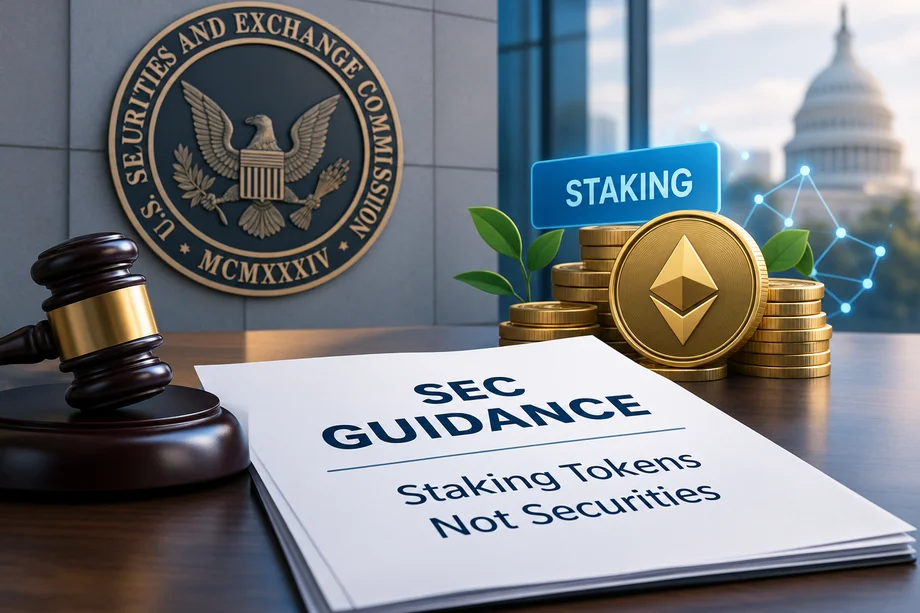
New FAQs from the Division of Corporation Finance outline when certain staking receipts, token buybacks and ongoing development activities fall outside investment-contract treatment under federal securities laws
The staff of the U.S. Securities and Exchange Commission’s Division of Corporation Finance released a set of frequently asked questions on September 25 addressing how federal securities laws apply to specific crypto assets and related transactions. The answers build on the Commission’s March 17 interpretive release classifying certain crypto assets and focus on staking receipt tokens, token buybacks, network maintenance and marketing communications.
The FAQs represent the views of Division staff only. They are not rules, regulations or statements of the Commission, which has neither approved nor disapproved their content. The guidance does not create new legal obligations or change existing law. Analysis continues to rest on the Howey investment-contract test and the facts and circumstances of each case.
Staking Receipt Tokens Treated as Digital Tools or Commodities in Defined Cases
Staff stated that a staking receipt token issued as a receipt for a digital commodity that is not itself subject to an investment contract qualifies as a digital tool. In that role, the token serves the practical function of evidencing the holder’s ownership of the underlying digital commodity.
A staking receipt token may instead be classified as a digital commodity when issued by a protocol-based liquid staking provider. Under those conditions, the token is intrinsically linked to and derives its value from the programmatic operation of a functional crypto system together with ordinary supply and demand dynamics.
The interpretation does not create a blanket exemption. A receipt token that represents a digital security, or one still tied to an investment contract, remains a security.
Functional Networks and Ongoing Development Activities
Once a crypto system is functional, services to secure, maintain, improve or enhance the system or its functionality, or to facilitate network effects, do not constitute essential managerial efforts under the Howey test. This includes sponsoring or funding development projects and similar activities.
Staff indicated that statements concerning a functional decentralized network generally do not create a new investment contract where no central party controls the network’s success or failure. Ongoing software updates, security work and network growth can continue without meeting the essential-managerial-efforts standard that would keep an asset within the investment-contract framework.
Token Buybacks Distinguished by Network Status
For a functional crypto system, an issuer’s announcement of a buyback program involving a non-security crypto asset does not, by itself, amount to a representation or promise to undertake essential managerial efforts.
The analysis differs when the crypto system is not yet functional. In that setting, a buyback announcement can constitute such a representation or promise if the issuer presents the program as creating yield or returns for token holders.
Marketing, Promotions and Trading Platforms
Whether promotional and marketing communications amount to representations or promises of essential managerial efforts depends on the specific facts. Encouraging the current utility of a system generally does not meet that standard. General statements about future features may also fall outside it, provided they do not directly link planned issuer activities to expected investor profits.
A secondary-market trading platform is treated as a promoter only if it satisfies the definition of “promoter” under Securities Act Rule 405. Merely operating a platform does not automatically create that status or related securities-law obligations.
The FAQs also note that a crypto asset previously sold under an investment contract may later separate from that contract if buyers no longer reasonably expect profits from the issuer’s essential managerial efforts.
Staff reiterated that determinations remain case-specific and that the answers do not alter the existing legal framework established by the March interpretive release and longstanding securities-law precedents.
Disclaimer
This article was generated by AI using information from multiple industry sources. It has not been reviewed or verified by a human editor and may contain inaccuracies, omissions, or misinformation. Readers are encouraged to independently verify any information before making decisions based on its content.Tired of the noise?
Let the bots trade for you.
Trade 24/7, without emotion, with data-driven strategies.
Associated articles

SEC Sets August 24 Deadline for Nasdaq Bitcoin Options Review After CME Challenge

CFTC Sets First Innovation Committee Meeting on Crypto Rules Amid Stalled Legislation
SEC Approves Nasdaq Texas Rule Change Listing Bitcoin, Ethereum, XRP and Solana as Digital Commodities

CFTC Expands No-Action Relief for Passive Software Linking Users to Regulated Derivatives

Citadel Securities Invests $400 Million in Crypto.com at $20 Billion Valuation
Latest articles

Network School Acquires Farcaster, Rebrands as Network State Protocol with New User Rules

US Judge Rejects Gemini and CFTC Bid to Void $5 Million Settlement

Capital B Posts $78 Million H1 Loss on Bitcoin Impairment While Expanding Holdings

Solana Accelerate China Event in Shanghai Suspended After Police Presence Reported