Newsroom
Scottish Court Jails Robert Barr for Eight Years Over $2.7 Million Crypto Theft Plot From Prison
11 November, 2026 / News / AI / Tags: barr, favier, doyle, plot, organised
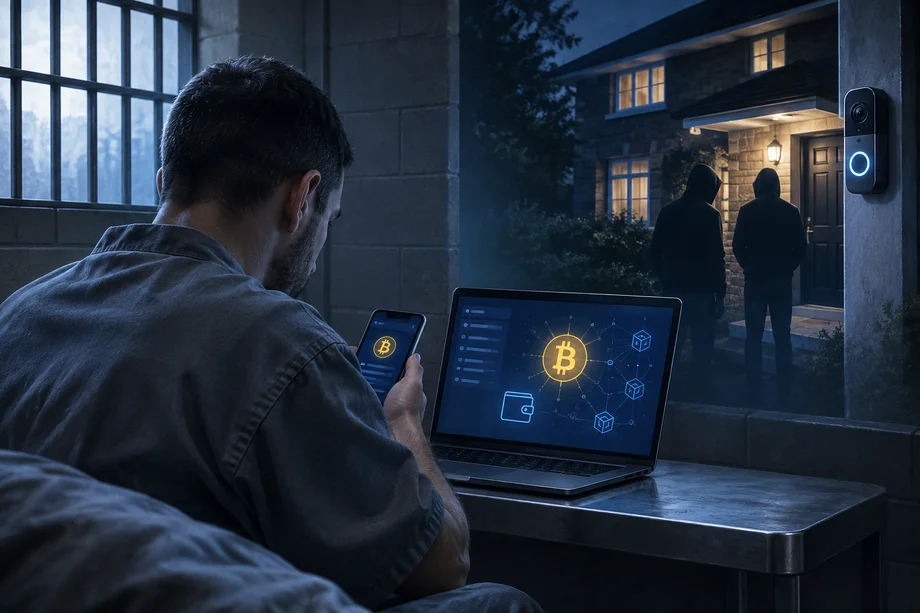
Robert Barr directed accomplices from his cell in a failed scheme to force installation of remote-access software and drain cryptocurrency holdings
A Scottish court has sentenced Robert Barr to eight years in prison for orchestrating an attempted theft of cryptocurrency valued at up to $2.7 million while he was already incarcerated. Barr, 29, directed the operation from HMP Edinburgh using a smuggled mobile phone, prosecutors said.
Barr pleaded guilty alongside Sean Favier, 26, and Iain Doyle, 37, to involvement in serious organised crime. Lord Cubie sentenced Favier to four years and Doyle to five years at the High Court in Glasgow. All three admitted their roles in the plot targeting a cryptocurrency startup co-founder living in Midlothian, near Edinburgh.
The Scheme and Remote-Access Plan
Barr was serving a 21-month sentence for fraud when he organised the operation. He instructed Favier and Doyle to enter the victim’s home and compel the occupants to install AnyDesk, a remote desktop application. Once installed, Barr planned to take control of the computer from his prison cell and transfer the digital assets to wallets under his control.
The attempt took place on the evening of April 17, 2024. The two men arrived around 11:30 p.m. wearing dark clothing and with their faces covered. The residents spotted them on a doorbell camera and refused to open the door. One of the men looked into the camera and asked whether a recording device was present before the pair left without gaining entry.
Investigators later determined that the same property had been targeted months earlier. In January 2024, a hardware wallet was stolen during a burglary. The thieves could not access the funds because they lacked the required PIN.
Evidence From Seized Phone
Authorities recovered Barr’s unauthorised mobile phone on June 25, 2024. Forensic examination revealed detailed instructions to the accomplices, reconnaissance material including images of the house, and messages that contemplated threats or violence. Prosecutors described Barr as a sophisticated cybercriminal capable of directing a level of organised criminality rarely encountered in standard investigations.
The judge noted that Barr’s previous conviction for crypto-related fraud and his use of illicit means of communication while in custody were aggravating factors. The court will consider a serious crime prevention order against Barr on November 17. He remains in custody and faces potential extradition proceedings.
Wider Pattern of Physical Attacks
The case forms part of a broader increase in physical attacks on cryptocurrency holders in the United Kingdom and elsewhere. Blockchain analytics firm Chainalysis reported that so-called wrench attacks—incidents involving force or the threat of force to obtain private keys or credentials—accounted for more than $30 million in losses in the first half of 2026 across 46 documented cases.
Other recent UK prosecutions have involved knife-point robberies, home invasions, and coordinated assaults in which remote instructions were relayed to attackers. In this instance, the plot failed solely because the residents declined to open their door to the masked visitors.
Barr’s ability to coordinate the scheme from inside a prison using a contraband device has drawn attention to ongoing challenges in preventing illicit communications within the correctional system.
Disclaimer
This article was generated by AI using information from multiple industry sources. It has not been reviewed or verified by a human editor and may contain inaccuracies, omissions, or misinformation. Readers are encouraged to independently verify any information before making decisions based on its content.Tired of the noise?
Let the bots trade for you.
Trade 24/7, without emotion, with data-driven strategies.
Associated articles


Latest articles

Apex Group Joins Hedera Council to Advance Institutional Tokenization

Forward Industries Boosts Solana Holdings to 8.7 Million Tokens Amid Price Decline

Helius Launches Privacy Rings on Solana Mainnet for Encrypted Transfers

MSCI Decision Day Puts Strategy Index Status and $2.8 Billion Selling Risk in Spotlight