Newsroom
Major Websites Compromised in Attack to Steal Crypto and Infect iPhones
17 November, 2026 / News / AI / Tags: optimizely, snippets, javascript, malicious, code
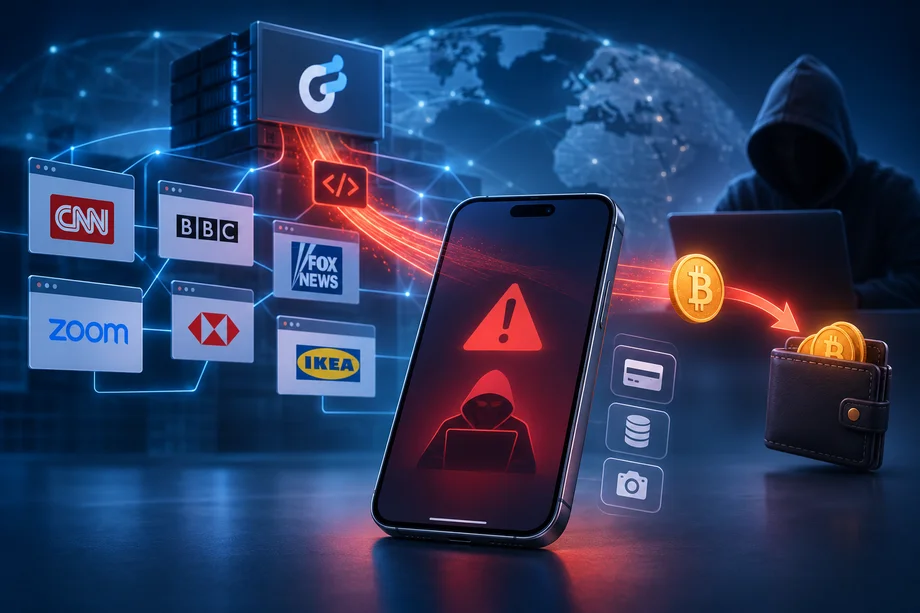
Malicious JavaScript delivered through Optimizely hit 178 organizations including Zoom, CNN, HSBC and IKEA, targeting wallets, cards and iOS devices on November 16
A widespread supply-chain attack delivered malicious JavaScript to visitors of 178 organizations on November 16, 2026, in an effort to steal cryptocurrency, harvest payment card details and install exploit code on iPhones and iPads. The code was injected into customer projects on the Optimizely Web experimentation platform, allowing it to load from a trusted domain already used by the affected sites.
Security researcher Scott Helme identified the activity after detecting unexpected scripts served through Optimizely snippets. Cybersecurity firm HudsonRock separately confirmed that infected code reached site visitors. The full scale of successful compromises remains unclear.
How the Attack Worked
Optimizely Web allows companies to run experiments by loading JavaScript snippets from its content delivery network. Attackers modified the Project JavaScript field in multiple customer accounts so that every visitor received an additional payload. The malicious code continued to be served under Optimizely’s domain and certificate, giving it the appearance of a legitimate third-party resource.
The payload performed several actions at once. It searched pages for cryptocurrency wallet addresses across major chains and replaced them with addresses controlled by the attackers. It monitored form submissions and network requests for credit and debit card numbers, expiry dates and security codes, then transmitted those details. It also collected non-HttpOnly cookies and captured screenshots of pages when wallet or payment-related content was present.
On Apple devices the same script attempted to load exploit chains. For older iOS versions it delivered the Coruna kit; for more recent releases it used DarkSword. Devices running iOS 18.7.3 or later, or iOS 26.3 or later, are reported to be patched against the known chains used in the campaign.
Organizations Affected
The infected snippets belonged to companies across banking, technology, retail, media, travel, healthcare and other sectors. High-profile names included Zoom, the BBC, CNN, Fox News, Salesforce, GitLab, IKEA, HSBC, Equifax, Air France-KLM, Ledger and Peacock. Additional affected entities ranged from payment processors and airlines to fashion retailers and streaming services.
Researchers examined more than 1,600 Optimizely snippets and found malicious code in 188 of them, corresponding to 178 organizations. The true number may be higher because not every snippet could be checked in time. By late evening on November 16 most of the infected code had been removed, with only isolated remnants remaining.
Financial Impact Observed
Within the first nine hours of the attack the attackers’ wallets received approximately 7,040 dollars in cryptocurrency. Transactions involved Bitcoin, Litecoin, TRON-based assets and Ethereum. Funds were later moved to exchanges. The volume of card data or session cookies successfully collected has not been publicly quantified.
Salesforce stated it was investigating unauthorized script modifications and had disabled Optimizely as a precaution. Equifax examined the issue, stopped using the service and reported no evidence that its own systems had been breached. Other named organizations did not issue immediate public statements.
Advice for Users and Site Operators
Anyone who visited an affected website on November 16 is advised to update iPhones and iPads to iOS 18.7.3 or later, or to iOS 26.3 or later. Cryptocurrency users should review transaction histories and wallet addresses used that day. Cardholders should monitor statements for unexpected charges, particularly for payments made on the impacted sites.
Organizations that rely on Optimizely were urged to review account access controls, audit custom Project JavaScript, and notify customers if malicious code had been served. The incident demonstrates how a single third-party platform can become a vector for large-scale distribution of malware without requiring direct compromise of each target website.
Most malicious snippets were cleaned by the evening of November 16. Investigations into how the attackers obtained write access to numerous unrelated customer projects continue.
Disclaimer
This article was generated by AI using information from multiple industry sources. It has not been reviewed or verified by a human editor and may contain inaccuracies, omissions, or misinformation. Readers are encouraged to independently verify any information before making decisions based on its content.Tired of the noise?
Let the bots trade for you.
Trade 24/7, without emotion, with data-driven strategies.
Associated articles
DarkSword iOS Exploit Still Targets Crypto Wallets on Vulnerable Devices

BitBox Issues Urgent Firmware Update for Two Severe Wallet Flaws

Fake Claude Desktop App Spreads RevStealer Malware Targeting Over 50 Crypto Wallets
Binance Flags iOS Flaw That Could Expose Crypto Wallet Keys on iPhones
Latest articles

Binance Wallet Closes $500 Million Anthropic Tokenized Stock Campaign After Cap Hit

XRP Ledger Secures Independent Verification of Architecture and Resiliency Under Global Framework

ZachXBT Claims Indian Authorities Wrongly Froze $3M Gate Account in Scam Probe

Vitalik Buterin Urges Crypto to Build Long-Term Stability Like Housing