Newsroom
JPMorgan Expands Tokenized Money Market Funds to Solana Blockchain
23 October, 2026 / News / AI / Tags: jltxx, morgan, mony, solana, money
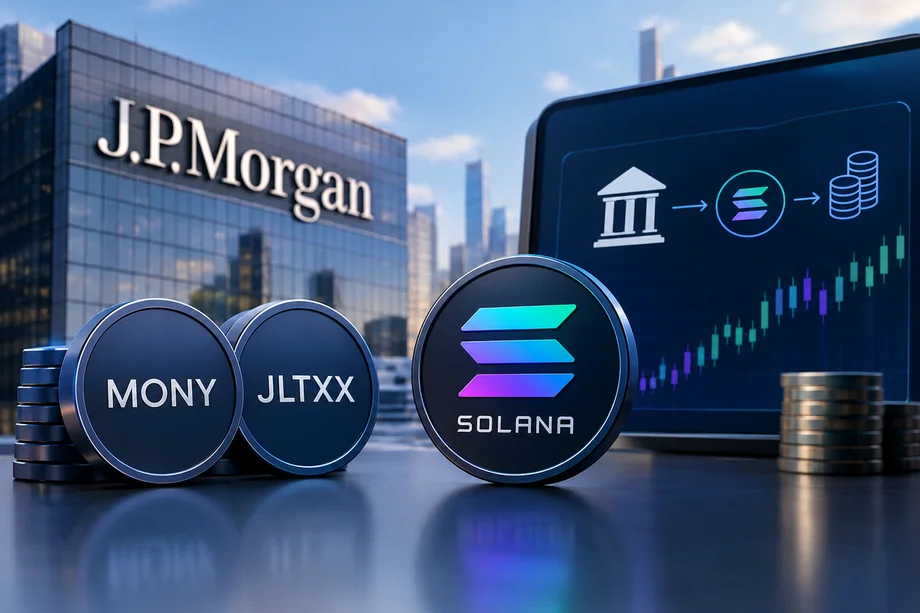
J.P. Morgan Asset Management makes MONY and JLTXX available on Solana for qualified U.S. investors via its Morgan Money platform, extending multi-chain access for institutional cash management
J.P. Morgan Asset Management announced on October 22, 2026, that its two tokenized money market funds are now available on the Solana blockchain. The products, My OnChain Net Yield Fund (MONY) and JPMorgan OnChain Liquidity–Token Money Market Fund (JLTXX),can be accessed by qualified U.S. investors through the firm’s Morgan Money platform.
Investors subscribe and redeem shares via Morgan Money and receive corresponding token balances at their blockchain addresses. The single-platform approach consolidates fund transactions and token-balance management. Both funds previously operated on Ethereum, and the Solana deployment advances the firm’s multi-chain strategy for tokenized cash products.
Fund Structures and Investor Eligibility
MONY is structured as a Rule 506(c) private placement. Launched in December 2025, it offers qualified investors exposure to U.S. dollar yields through holdings of U.S. Treasury securities and Treasury-backed repurchase agreements. Access is limited to accredited investors and qualified purchasers. Documentation lists a $1 million initial investment minimum and fees of 16 basis points. Official shareholder records remain offchain, while tokens are issued to approved blockchain addresses.
JLTXX is a U.S.-registered government money market fund. It is designed to invest in a manner that supports stablecoin issuers under the GENIUS Act. The fund focuses on U.S. Treasuries and overnight repurchase agreements fully collateralized by Treasuries or cash. Purchases, redemptions, and token transfers require approved wallet addresses. An opening minimum of $1 million applies, with no subsequent minimum and the possibility of waivers. Annual operating expenses after waivers are listed at 0.16 percent through June 30, 2028.
Neither product is a stablecoin. Legal ownership is determined by the transfer agent’s investor register; token balances are intended to correspond to shares, though temporary differences can occur when blockchain instructions arrive outside business hours.
Platform Access and Operational Details
Morgan Money serves as the open-architecture trading and analytics platform for liquidity management. Qualified investors use it to subscribe to or redeem the tokenized funds and receive tokens at their designated addresses. The firm reported $4.8 trillion in assets under management as of September 30, 2026.
The official Solana token addresses are EToDtBM2knZ8N1BHyUq2Riq5ngWTcoD3k6qpsgf7CKYY for MONY and J4cTuCH6frt4AnEmKfMS2k8hsUf7K94PV62sjUJno8Cz for JLTXX. The expansion does not open the products to retail investors; eligibility requirements remain in place for both funds.
Broader Context of Tokenized Cash Products
The Solana availability follows the funds’ initial deployments on Ethereum. MONY launched on that network in December 2025, when J.P. Morgan Asset Management became the largest global systemically important bank to introduce a tokenized money market fund on a public blockchain. JLTXX followed later as a registered vehicle oriented toward stablecoin reserve management.
Other asset managers have previously added Solana support for similar products. BlackRock expanded its BUIDL fund to the network in March 2025, and Franklin Templeton added Solana for its on-chain U.S. government money fund in February 2025. These developments form part of a wider industry effort to represent traditional money market instruments as digital tokens on public blockchains.
Blockchain technology introduces operational considerations, including potential transaction delays, security risks, regulatory changes, and network-specific fees. Investors must safeguard private keys, and differences from traditional mutual-fund processes may affect how certain issues are resolved.

Disclaimer
This article was generated by AI using information from multiple industry sources. It has not been reviewed or verified by a human editor and may contain inaccuracies, omissions, or misinformation. Readers are encouraged to independently verify any information before making decisions based on its content.Tired of the noise?
Let the bots trade for you.
Trade 24/7, without emotion, with data-driven strategies.
Associated articles
BlackRock Rolls Out Tokenized Money Market Funds Aimed at Stablecoin Reserves

WisdomTree Partners with MoonPay to Expand U.S. Access to Tokenized Money Market Fund
Franklin Templeton Partners with HashKey to Offer Tokenized U.S. Money Fund in Asia
KB Securities Partners With Securitize and Optimism to Tokenize Korean Funds on OP Mainnet

BlackRock’s BUIDL Fund Surges Past $900 Million on Avalanche
Latest articles

Dropee Daily Quiz Archives Cover Four Months of Startup and Business Terms in 2026
Aave V4 Debuts Externally Curated Lending Markets Managed by Sentora on Ethereum

HSBC Begins Phased Rollout of HKD-Backed RedCoin Stablecoin to 3.3 Million PayMe Users
Solana Meme Coin Kimchi Plunges 98% After Pump.fun Co-Founder Removes Promotion