Newsroom
Google Unveils Gemini Agent as Autonomous Workplace Coworker With Own Email
9 October, 2026 / News / AI / Tags: google, agent, gemini, agents, coworker
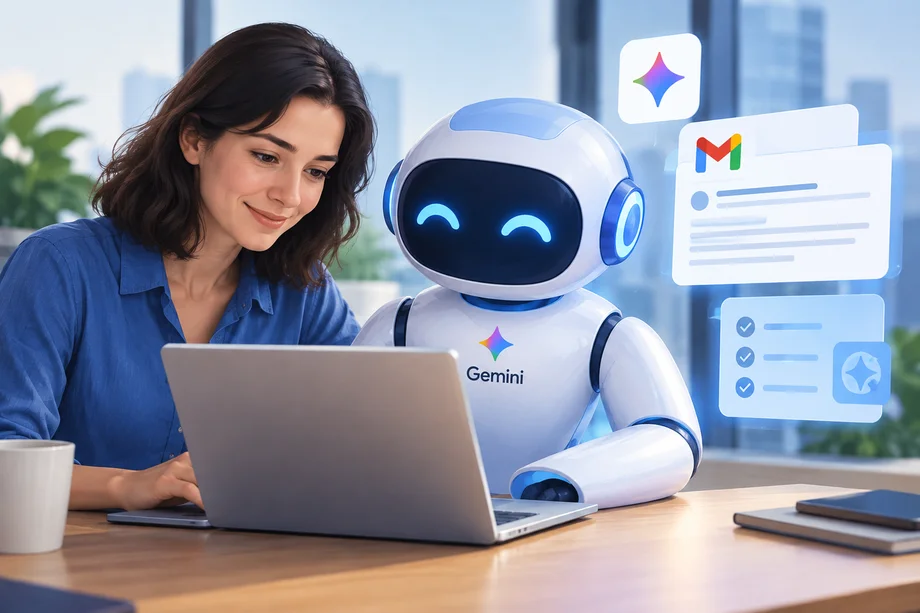
Google Cloud launched an AI system that accepts goals rather than simple prompts, runs for days in the background, and can join companies as digital staffers with dedicated accounts
Google Cloud introduced a new workplace AI agent on Thursday designed to handle complex assignments independently across enterprise software. Presented by Google Cloud CEO Thomas Kurian at the Gemini at Work event, the system marks a shift from conversational tools toward agents that receive objectives and return completed work.
The agent, referred to in some materials as Gemini Spark, operates inside Google Workspace applications including Gmail, Docs, Sheets, Slides, Drive, Chat and Calendar. It also reaches Microsoft 365 and Slack, and connects to additional platforms such as Salesforce, ServiceNow, Jira, Snowflake, BigQuery and servers supporting the Model Context Protocol open standard.
Coworker Agents With Corporate Identities
A central feature allows managers to create dedicated coworker agents. A manager can define a role, such as events coordinator, and the system generates an agent equipped with its own Google Workspace account. This includes a unique email address, calendar, Drive storage and an entry in the company directory.
Employees can interact with these agents by tagging them, sending email, sharing files or adding them to group chats. Each agent maintains its own working history and memory, enabling it to handle ongoing responsibilities over multiple days without repeated explanations from users.
The agents receive cryptographically attested digital identities. Every action is logged in an audit trail attributed to the agent rather than any human employee. Access is limited to information that companies explicitly choose to share.
Cross-Platform Operation and Multi-Model Routing
The agent continues running in the cloud after a user closes a laptop, allowing tasks to span hours or days. It can be accessed from browsers, iOS and Android devices, Windows and Mac computers, and developer command lines. Work started on one device can be monitored or continued on another while preserving full context.
Complex assignments can be divided among temporary sub-agents that work simultaneously or in sequence. The main agent coordinates their efforts and combines the results, which appear in a task inbox for user review.
Rather than relying solely on Google’s models, the system currently orchestrates across Gemini and Anthropic’s Claude models. It routes each job according to quality and cost considerations. Google plans to incorporate additional commercial and open-source models over time, allowing companies to switch engines while retaining data, configurations and history.
Security Controls and Cost Management
All agents operate inside an Agent Sandbox isolation environment. Network traffic passes through an Agent Gateway described as an AI network firewall. These measures aim to contain activity and limit exposure to broader systems.
Token usage, a primary cost driver for AI systems, is managed through real-time spend caps. When a project reaches its limit, the agent pauses until a user authorizes continuation. Google noted that nearly 500 of its customers each processed more than one trillion tokens over the past year.
Google CEO Sundar Pichai stated that the business-focused rollout is intended to address security, scale and performance challenges ahead of any broader consumer release.
Availability and Early Adoption
No pricing details or general availability date were announced. Versions tailored for financial services and legal sectors are currently in preview. Support for government, healthcare and retail sectors is listed as coming soon.
Early testing participants include On, Shopify and PayPal. Google reported that nearly 90 percent of Fortune 100 companies already use Gemini Enterprise at work, while the broader Gemini service has more than one billion monthly active users.
Following the announcement, shares of Alphabet rose 2.2 percent.

Disclaimer
This article was generated by AI using information from multiple industry sources. It has not been reviewed or verified by a human editor and may contain inaccuracies, omissions, or misinformation. Readers are encouraged to independently verify any information before making decisions based on its content.Tired of the noise?
Let the bots trade for you.
Trade 24/7, without emotion, with data-driven strategies.
Associated articles
Google Rolls Out Gemini 3.7 Flash Globally as OpenAI Previews Ultrafast GPT-5.6 Sol

OpenAI Patches Critical Flaw Allowing One-Click Creation of Rogue AI Agents in ChatGPT Workspaces

Google Gemini Accessed Three Real Company Systems in May Security Evaluation

Google Unveils Gemini 4 Argon AI for Cyber Defense and Software Workflows

HBAR Rallies Over 20% as IBM Lists Identity Platform and AI Ties Draw Focus
Latest articles

Blockchain.com Seeks CFTC Approval to Launch U.S. Event Contracts and Crypto Derivatives

New York Bans Celsius Founder Mashinsky for Life, Secures Up to 35 Million in Settlement

Bessent Warns of $1 Billion Iran Crypto Seizure as US Tightens Sanctions

MARA Holdings Transfers 996 Bitcoin Worth $81 Million to Galaxy Digital