Newsroom
Ethereum Draft Proposes Four-Minute Finality to Accelerate Crypto Settlements
23 October, 2026 / News / AI / Tags: finality, draft, minutes, voting, would
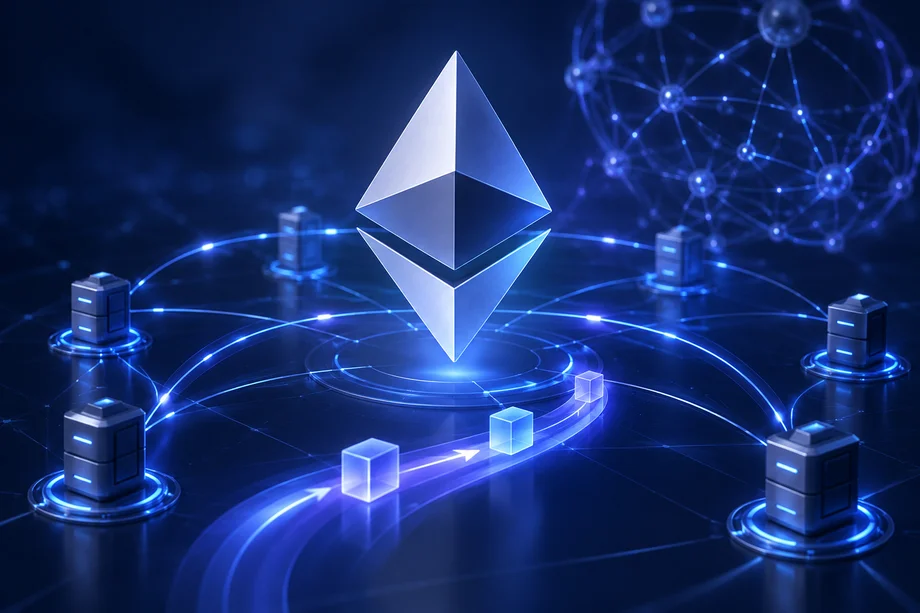
Ethereum researchers have filed a draft proposal that would cut the network’s expected transaction finality from 16 minutes to about four minutes by decoupling block selection from finality voting, with broader benefits for capital efficiency and security
Proposal Separates Voting Duties to Enable Faster Settlement
Ethereum’s consensus mechanism currently requires two rounds of voting over epochs to reach finality, resulting in an expected wait of 960 seconds or 16 minutes for transactions to become irreversible. The new draft, submitted October 21 and assigned EIP-8453, introduces a fundamental redesign by assigning distinct responsibilities to validators. One smaller committee of roughly 512 validators would focus solely on selecting the chain head each slot, while the full validator set would cast finality votes on a separate schedule, requiring at least two-thirds of active stake.
Ben Edgington, who coordinated the fast-finality effort, described the approach in earlier foundational work as a way to improve reorg resilience and enable quicker finality without compromising the network’s security guarantees. The change would allow finality votes to advance independently of slot-by-slot block production, potentially reducing the unfinalized tail of the chain that remains vulnerable to reorganization.
Benefits for Capital and Cross-Chain Transfers
Services that advance funds on destination networks while Ethereum transactions await finality could recycle liquidity more quickly. A hypothetical example illustrates the potential impact: a provider advancing $1 million per hour might tie up around $267,000 for 16 minutes. At a four-minute finality window, that figure would drop to roughly $67,000, freeing approximately $200,000 in working capital per hour under the same activity level. The proposal does not provide a precise cost estimate or predict changes to user fees.
Layer-2 rollups, bridges, and interop protocols stand to gain most directly. Deposits, force-included transactions, and cross-chain messaging currently rely on waiting for full finality, which can delay onboarding and interop flows. Faster settlement would also improve transaction pricing accuracy for L2s, as blob data and deposit processing would reflect more recent finalized state rather than waits of 15 minutes or more.
Additional Security and Long-Term Considerations
The architecture strengthens defenses against certain reorganization attacks by allowing temporary voting locks and expiring votes. It also lays groundwork for later integration of quantum-resistant cryptography, though the draft does not implement post-quantum signatures itself. Conflicting attestations would remain slashable, preserving economic incentives for honest participation.
Stakeholder research involving bridges, L2 teams, payment providers, and institutional users highlighted demand for finality under one minute among many applications, alongside the need to maintain Ethereum’s core properties of censorship resistance and decentralization. The design keeps availability of the chain intact, ensuring blocks continue to be produced even if finality lags slightly behind.
Implementation Requires Further Work
The draft remains preliminary, with many technical details—such as exact committee selection, voting schedules, penalties, and security analysis—still to be resolved. A consensus-layer hard fork would be necessary for activation, and no timeline has been set. Ethereum Foundation research positions the four-minute target as an initial milestone in a broader effort to reach tens of seconds or less while preserving the network’s robustness.
Further parameter analysis and editor reviews are required before the proposal can proceed to implementation. The separation of duties offers a modular path forward, allowing incremental improvements without overhauling the entire consensus process at once.

Disclaimer
This article was generated by AI using information from multiple industry sources. It has not been reviewed or verified by a human editor and may contain inaccuracies, omissions, or misinformation. Readers are encouraged to independently verify any information before making decisions based on its content.Tired of the noise?
Let the bots trade for you.
Trade 24/7, without emotion, with data-driven strategies.
Associated articles

Solana Advances Quantum-Resistant Security with Quantumglow Proposal

Solana Begins Testing Alpenglow Upgrade Targeting 150-Millisecond Finality
Solana Activates Alpenglow Upgrade for Sub-Second Transaction Finality

SharpLink CEO Opposes Ethereum Proposal EIP-8363 Over Staking Yield Risks

Ethereum Developers Draft Post-Quantum Deposit Contract to Retire BLS Signatures
Latest articles

Railway Halts Deployments After Unauthorized Access to Customer Secrets
Circle Shareholder Sues Trump Over Alleged Crypto Corruption in UAE Deals
Coinbase Schedules Nine-Hour Pause in Derivatives Trading

South Korea Advances Crypto Framework as Tax Deadline Draws Near