Newsroom
DuckDuckGo Courts Schools After Google Links Search Access to AI Tools
5 November, 2026 / News / AI / Tags: duckduckgo, google, schools, search, classroom
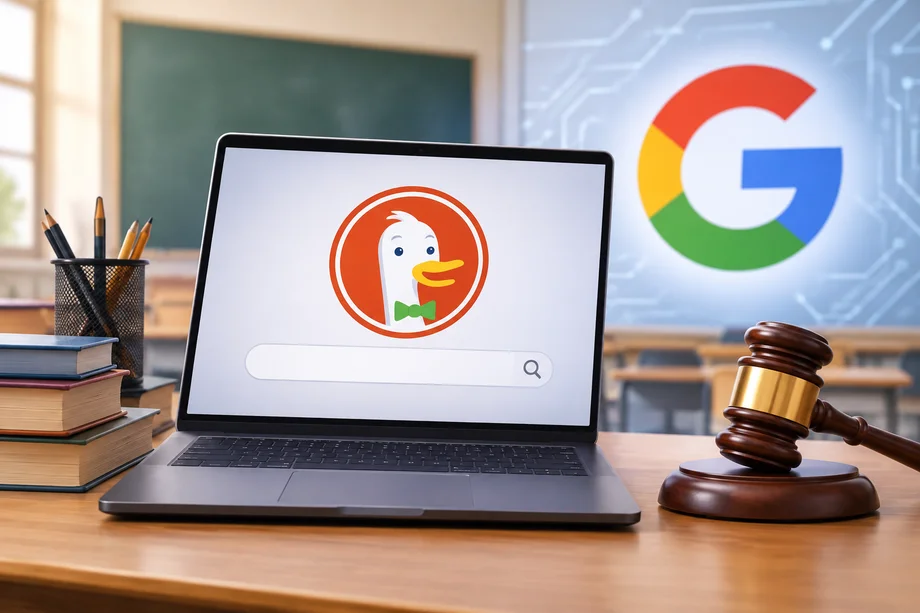
Privacy-focused search firm pitches default settings to educators seeking control over classroom AI following Google’s K-12 policy changes
DuckDuckGo is actively approaching schools that want greater authority over artificial intelligence tools in the classroom, positioning its search service as an alternative after Google updated controls for K-12 student accounts. The move follows Google’s decision to connect access to its Search product with certain AI features, a linkage that has drawn criticism from educators and competitors.
Google’s Updated Education Controls
On November 3, Google announced that Gemini, Gemini Notebook, and Search would be turned off by default for managed K-12 student accounts. School administrators can enable each service separately. Google described the change as a response to feedback from schools seeking more control over student use of AI tools.
A key restriction remains: schools that disable Google’s other AI features also lose access to Search. Google has stated that Search and AI are deeply integrated. Search includes AI Overviews and AI Mode, which generate answers using artificial intelligence. Administrators who prefer traditional search results without those AI components cannot retain Search while turning the AI elements off.
Google has also introduced Guided Learning within its search tools. The feature is designed to guide students through problem-solving steps rather than deliver complete answers immediately. The company maintains that the overall approach gives schools more choice by allowing individual activation of services.
DuckDuckGo’s Response and Offer
DuckDuckGo Chief Executive Officer Gabriel Weinberg shared documentation explaining how schools can set the company’s search engine as the default on managed devices. He invited educators to contact the company for assistance with the setup. The change applies primarily to searches initiated from the address bar and does not affect other Google services such as Classroom, Drive, or Docs.
DuckDuckGo’s chief public affairs officer, Kamyl Bazbaz, criticized Google’s policy in a public statement.
The company argues that Google could disable AI features within Search without removing the search product entirely. DuckDuckGo points to its own settings, which allow users to turn off AI features in both search and browser configurations. It also operates noai.duckduckgo.com, a version that automatically disables AI-assisted answers, AI-generated images, and related suggestions.
DuckDuckGo maintains its own AI offerings, including a chat interface and search assistant, but provides clear options to limit or remove them. The firm continues to emphasize reduced data collection as a core part of its service.
Scale of School Technology and Market Context
Schools currently use approximately 50 million Chromebooks. Google Classroom serves more than 150 million users worldwide. These figures illustrate the reach of Google’s education products and the potential impact of any shift in default search settings.
Earlier this year, DuckDuckGo reported a 30 percent rise in app installs amid broader user pushback against AI-heavy search experiences. The company has framed its school outreach as an opportunity for institutions that want search functionality without mandatory AI components.
Google has defended its policy as aligned with educator requests for better controls and improved learning tools. The company continues to engage with schools on implementation details as the changes prepare to take effect in the coming period.

Disclaimer
This article was generated by AI using information from multiple industry sources. It has not been reviewed or verified by a human editor and may contain inaccuracies, omissions, or misinformation. Readers are encouraged to independently verify any information before making decisions based on its content.Tired of the noise?
Let the bots trade for you.
Trade 24/7, without emotion, with data-driven strategies.
Associated articles


Latest articles

Injective Token Climbs as Canary Staked INJ ETF Begins Trading on Nasdaq

US Regulators Contact Banks Over Cyber Risks After $6.3 Billion Binance Breach

Ukraine Central Bank Rejects Crypto Regulation Bill Over Sovereignty and Monopoly Risks

Binance Revokes All SignalPlus API Keys After Potential Security Alert