Newsroom
Crypto Firms Push SEC to Review Novel ETFs Case by Case
2 September, 2026 / News / AI / Tags: products, grayscale, novel, council, registration
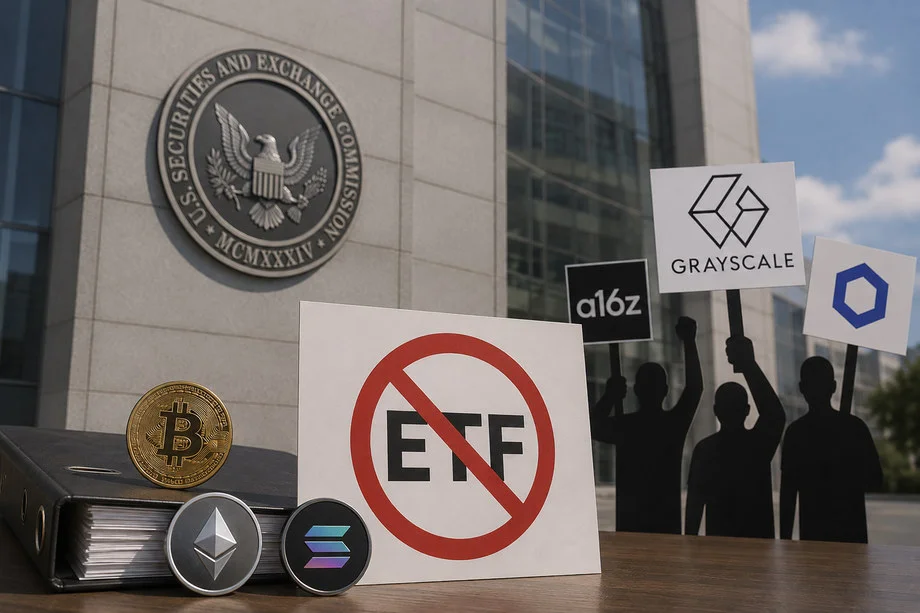
Grayscale, a16z and the Crypto Council for Innovation urge individual risk assessments rather than uniform restrictions as the agency reviews next-generation exchange-traded products
Major crypto industry participants have called on the U.S. Securities and Exchange Commission to evaluate so-called novel exchange-traded funds according to their specific characteristics and risks instead of applying broad, categorical rules. The comments arrived as a 60-day public consultation period closed.
Venture capital firm a16z, digital asset manager Grayscale Investments and the Crypto Council for Innovation submitted separate letters dated August 31. They responded to the SEC’s June 30 request for input on products that invest in innovative assets or pursue new strategies, including those involving crypto assets, private investments, leverage, blockchain features and event contracts.
Opposition to Uniform Treatment
The three organizations argued that products labeled novel present different liquidity, valuation, custody and operational profiles. Grouping them under a single regulatory approach, they said, risks imposing unnecessary conditions on offerings that already operate under established compliance frameworks.
a16z stated that regulators should examine each product’s economic structure and underlying risks. The firm noted that regulated crypto market infrastructure, disclosure practices and generic exchange listing standards have matured, setting certain digital asset products apart from less developed strategies such as those holding private securities.
Grayscale opposed additional portfolio conditions or disclosure requirements triggered solely by a novel designation. It maintained that funds with proven compliance records should continue to be reviewed under the rules that match their legal structure and assets. The firm stressed that regulators should identify concrete risks before layering on new constraints.
The Crypto Council for Innovation sought comparable treatment across ETFs and other exchange-traded products. It supported clear investor disclosures while cautioning against changes that could slow the path for otherwise eligible offerings.
Investment Company Classification Debate
A central point of contention involved the Investment Company Act of 1940. The SEC had asked whether products that primarily hold non-securities could still qualify as investment companies under the law’s objective and subjective tests.
All three commenters opposed modifications that would automatically bring exchange-traded products holding non-security assets under the Act. Such a shift could affect commodity trusts and many crypto products structured outside the investment company regime.
Spot crypto products have commonly used commodity-based trust structures. The SEC has traditionally referred to the spot Bitcoin products approved in January 2024 as exchange-traded products rather than ETFs. The distinction influences governance, registration obligations and the scope of investor protections, though it does not determine whether a product can list on a national exchange.
Views diverged on terminology. a16z proposed reserving the term ETF for open-end funds registered under the Investment Company Act. Grayscale countered that the label should track a product’s economic features rather than its legal wrapper. The Crypto Council for Innovation favored clearer disclosures about registration status so investors can distinguish the applicable rules without abandoning familiar market language.
Calls for Process Improvements
Industry letters also addressed the dual-track nature of reviews. Fund registration documents typically go to the Division of Investment Management, while exchange listing proposals fall under the Division of Trading and Markets.
a16z urged the agency to coordinate the two processes and establish more predictable timelines. Without alignment, an issuer might resolve registration questions only to face separate uncertainty over listing approval.
Grayscale and the Crypto Council for Innovation supported an optional confidential pre-filing process. Issuers could use early discussions to surface legal or disclosure issues before making public submissions, potentially reducing repeated amendments and avoidable delays. The proposals would leave intact the SEC’s authority to require changes, prevent effectiveness or reject related exchange filings.
The discussion follows the SEC’s September 2025 adoption of generic listing standards for commodity-based trust shares. Those standards allow qualifying spot crypto products to reach the market without product-specific exchange rule changes, shortening certain review periods while still requiring compliance with registration, custody, disclosure and exchange rules.
Consultation Remains Exploratory
The SEC’s request sought feedback on investment company classifications, portfolio conditions, disclosures and registration procedures. It did not propose a formal rule, ban any products or set a deadline for further action. Rule 6c-11, which allows qualifying ETFs to operate without individual exemptive orders, does not currently restrict assets or strategies, though other securities rules continue to apply.
SEC Chair Paul Atkins has stated that innovation depends on a consistent, transparent and efficient regulatory framework. U.S. ETF assets grew from more than $4 trillion in 2019 to over $12 trillion by the end of 2025.
The agency will now review the public comments. Possible next steps include issuing guidance, proposing amendments, adjusting staff procedures or taking no immediate action. Any formal rulemaking would require a separate public process. No timeline for a response has been announced.
Disclaimer
This article was generated by AI using information from multiple industry sources. It has not been reviewed or verified by a human editor and may contain inaccuracies, omissions, or misinformation. Readers are encouraged to independently verify any information before making decisions based on its content.Tired of the noise?
Let the bots trade for you.
Trade 24/7, without emotion, with data-driven strategies.
Associated articles

Ripple Backs SEC Proposed Crypto Asset Rules After $150 Million Legal Battle

SEC Advances Crypto Custody Rule Overhaul With White House Review

Japan Reclassifies Crypto as Financial Assets in Major Regulatory Shift

CFTC Unveils Optional Federal Rules for Leveraged Crypto Trading After Clarity Act Stalls

SEC Proposes Regulation Crypto Assets Framework Amid Stalled Congressional Bill
Latest articles

SpaceX and Tesla Set Up Committees to Explore Merger That Would Combine Holdings of Over 30,000 Bitcoins

UK Banks Face Thousands of Complaints Over Crypto Transfer Restrictions
Ripple Backs SEC Proposed Crypto Asset Rules After $150 Million Legal Battle

Blockchain.com Introduces Options Trading on Seven Major Crypto Assets
