Newsroom
BNY and Kraken Parent Payward Discuss Broad Crypto Infrastructure Partnership
2 October, 2026 / News / AI / Tags: payward, bny, custody, talks, discussions
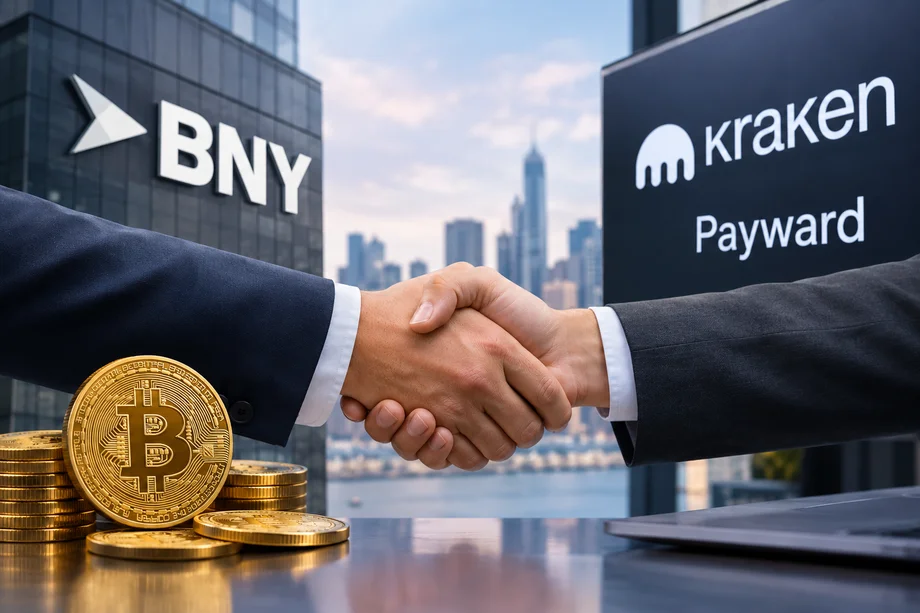
Wall Street custody giant BNY is negotiating with Payward, parent of crypto exchange Kraken, on a potential deal covering digital assets, custody, trading, payments and more
BNY is in discussions with Payward, the Wyoming-based parent company of cryptocurrency exchange Kraken, regarding a potential partnership that would link traditional financial services with digital asset infrastructure. The talks center on a multi-area collaboration that could extend across several business lines.
According to people familiar with the matter, the proposed arrangement spans six areas: crypto products, custody, wealth management, trading, payments and financial infrastructure. Services under discussion could be provided through Payward Services, the company’s business-to-business platform that supplies capabilities to banks, exchanges and asset managers.
Scope of the Potential Collaboration
The discussions describe a relationship broader than a single product or service. One person close to the talks noted that elements of the proposed partnership resemble the infrastructure components of Payward’s recent commercial agreement with Nasdaq. That earlier arrangement included investment, work on tokenized equities and market surveillance technology.
Payward Services already supports operations that include spot crypto trading, derivatives, tokenized equities, custody, staking, payments and traditional securities. On the banking side, BNY provides custody, asset servicing, clearing and wealth management to institutional clients. The bank has also advanced its own digital cash program, which creates blockchain records mirroring client deposit balances for use in collateral and margin workflows on a private, permissioned system.
Neither company has publicly confirmed the negotiations. Sources described the talks as private and still in progress.
Payward’s Recent Expansion and Institutional Ties
The potential BNY discussions come after a series of moves by Payward to deepen its institutional and infrastructure offerings. In September, Nasdaq Ventures agreed to invest $100 million in Payward, with the transaction reported at a $21 billion valuation. That deal also expanded collaboration on Nasdaq Equity Tokens, expected to launch in the second quarter of 2027, and included adoption of Nasdaq’s market surveillance technology across Payward’s trading venues.
Payward has completed several acquisitions that add regulated capabilities. It closed the purchase of Bitnomial, which brought a designated contract market, derivatives clearing organization and futures commission merchant registrations under the Commodity Futures Trading Commission framework. The company also acquired NinjaTrader, a retail futures platform, and completed a stablecoin payments transaction with Reap. An asset purchase agreement for Magic Labs’ wallet business added technology that had supported more than 60 million wallets and over $10 billion in stablecoin volume.
In its second-quarter results, Payward reported $508 million in adjusted revenue, up 17 percent year over year, with asset-based and other revenue accounting for 60 percent of the total.
BNY’s Digital Asset Activity
BNY, formerly known as Bank of New York Mellon and listed on the New York Stock Exchange under the ticker BK, ranks among the largest custody banks globally. The firm has expanded digital asset capabilities for institutional clients, including the deposit-tokenization program that began with collateral and margin use cases. Balances continue to appear in traditional bank records for regulatory and reporting purposes while existing risk, compliance and control frameworks govern the system.
A potential agreement with Payward would connect BNY’s established institutional franchise with Payward’s crypto-native infrastructure and B2B platform. The talks form part of a wider pattern of traditional finance firms exploring deeper operational links with digital asset platforms that have built regulated U.S. derivatives, payments and custody capabilities.
As of the latest reports, the negotiations have not produced a finalized agreement, and the companies have not issued public statements on the discussions.
Disclaimer
This article was generated by AI using information from multiple industry sources. It has not been reviewed or verified by a human editor and may contain inaccuracies, omissions, or misinformation. Readers are encouraged to independently verify any information before making decisions based on its content.Tired of the noise?
Let the bots trade for you.
Trade 24/7, without emotion, with data-driven strategies.
Associated articles
Wells Fargo in Talks With Kraken Parent Payward for Crypto Trading Liquidity
SoFi and Kraken Parent Link Banking Rails With Crypto Trading Infrastructure

Israel’s Largest Bank Partners With Galaxy for Crypto Trading Launch in 2027

BitGo Completes Acquisition of NYDIG Trading Unit as Crypto Firms Expand Institutional Offerings
Payward and Franklin Templeton Forge Landmark Partnership to Tokenize Wall Street Assets
Latest articles
CoinDCX Confirms Losses After Suspicious $16M Transfers From 2025 Hack Wallets

Robinhood Secures Dubai License for Crypto and Stock Trading, Middle East Launch Delayed to 2027

CZ Warns Crypto Users Over Two Critical PHP Vulnerabilities

Bybit Fintech FZE Receives VARA Licence for Dubai Spot Trading